
Hype and customers
Hype is the meter everything else feeds into. The star icon in the middle of the HUD carries a number, and the store page spells out the trade: more Hype means faster progression, and more people means more money and more chaos.
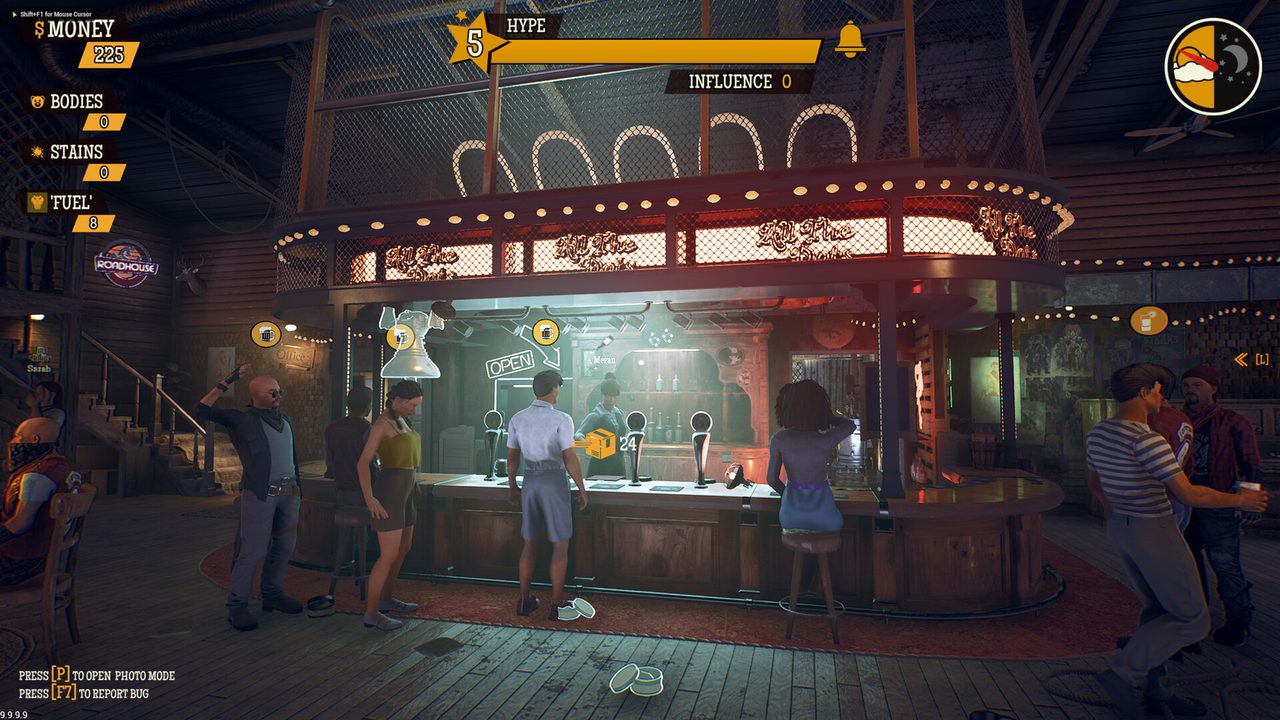
How Hype behaves
- It is a count plus a bar — the number next to the star is your current level (official screenshots show values like 4, 5 and 6).
- It rises from service quality and entertainment: drinks delivered, attractions running, pigs racing, slots spinning.
INFLUENCEsits directly underneath it. In DRAGO's own words the goal is to "spread your influence in the nearby areas", and the management screen tracksINFLUENCEandOWNED TERRITORIESas separate readouts.
What more customers actually buy you
| With low Hype | With high Hype |
|---|---|
| Few orders, quiet room, easy cleanup | More orders per minute, more tips, faster level growth |
| Fights are rare and isolated | Brawls chain, furniture dies, evidence stacks up |
| You can personally serve, mop and fix everything | You cannot — staff and attractions are mandatory |
The honest reading: Hype is a lever, and the failure mode is pulling it before you have hands to handle it. A one-person bar at Hype 6 is not a success state; it is a fire.
Raising Hype without raising it too fast
- Serve clean rounds. Every completed order nudges the meter. Dropped and spilled drinks do not.
- Keep attractions running. The objective feed flags them ("Attraction needs attention x1") — a stalled attraction is money and Hype both going flat.
- Stock the vending machine and shelves. Empty shelves mid-rush cancel the crowd you already paid for.
- Then add entertainers. Slots, pig racing and (if you dare) the underground Fight Club are the Hype engines that do not need your hands.
Customer types and how to read them
- Civilians — ordinary paying customers. They leave when unserved and they snitch when things get ugly.
- Gangsters — the management screen counts them separately (
GANGSTERS 10/CIVILIANS 7). Big spenders, big risks: rival gangs turn a normal night into a gang fight. - Drunks — the escalation risk. Player reports describe drunk patrons standing up to fight when provoked, including by an accidental serve.
- Troublemakers at the door — your bouncer phase is literally about spotting these before they are inside.
Keeping the room from boiling over
- Watch the entrances, not just the bar. Rival gang members arriving together is the signal for a bad night.
- Break up fights early. "Customers are fighting x1" is cheap to resolve; "x3" costs furniture and dignity.
- Clean continuously. Bodies and stains are the visible half of the law system.
- Pay your staff. Unpaid crew is a slower-motion version of the same fire.
The chaos side of the store promise
DRAGO's own feature text warns about more people meaning more chaos — and their community posts lean into it: devlogs cover save-file bugs where vomit and blood decals grew every time you loaded a save. That is the tone of this game. Plan for a bar that gets ruined on a good night.
Unconfirmed at launch
The exact Hype thresholds, decay rate, and how much each attraction contributes. RH LEVEL and INFLUENCE exist as tracked values; the earning curve behind them is not something the release build has confirmed to us yet.
Next: Fighting & the Snake · Pig Racing & the Fight Club · Gangs & the Sheriff